 |
 |
|
| . |
What
is Orthokeratology?
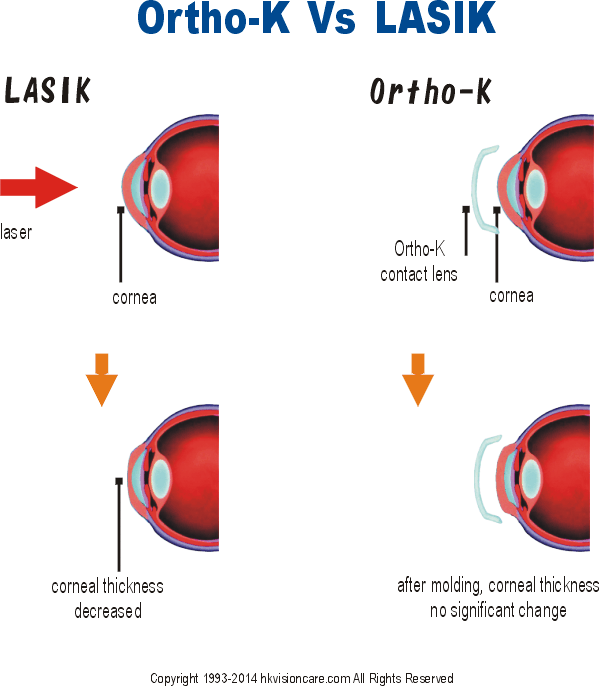
"OrthoKeratology" (Ortho-K) is a non-surgical process which reshapes the cornea of the eye utilizing special contact lenses and thereby reduces the dependence upon eyewear. The procedure was discovered over 40 years ago when eye doctors noticed that some contact lens wearers' vision improved after wearing their lenses. Early on, only old-fashioned, hard contact lens material (PMMA) was used. Ortho-K is best suited for myopia (nearsightedness), but studies are underway for hyperopia (farsightedness). 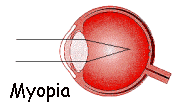
|
|
|
|
||
| . |
The cornea makes up about two-thirds of the eye's total power to focus the light precisely on the retina (receiving screen) which is located in the back of the eye. By slight modifications in the shape of the cornea, clear functional vision may be restored for a period of time. Recently, several surgical procedures have been developed to attempt to accomplish the same purpose (i.e., changing the curvature of the cornea). Since the cornea is soft, it can continue to change shape as time goes by. The individual prescription may continue to vary leading to increased dependence upon eyewear within months to just a few years after the surgical procedure. Some surgical procedures produce scars causing surface irregularities on the cornea, resulting in permanent blurring that even glasses or contacts cannot eliminate.
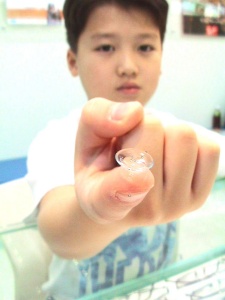
Conversely, Ortho-K is accomplished with a contact lens device that may be referred to as a corneal mold. The mold is similar to a contact lens in its appearance and the way it feels while being worn. The mold is working as it is worn, whether you are sleeping or awake. The procedure takes just from hours (in mild cases) to a few weeks (in very difficult cases) to reach good functional vision. At that point, the mold-wearing time is gradually reduced until a minimal-wear time is established that maintains the corneal shape and good functional vision. This assures continued clarity without the gradual blurring that may accompany surgery. Therefore, the cornea can easily be fine-tuned by minor modifications to the retainer mold.
|
||
|
|
|||
| . |
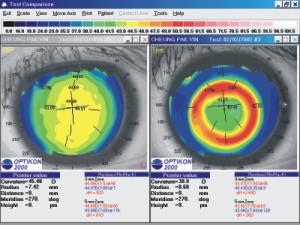
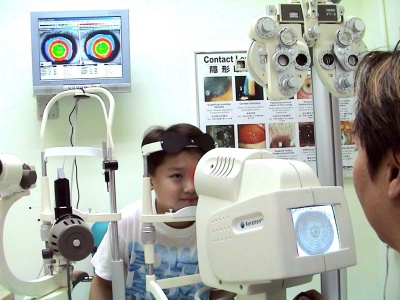
Ortho-K utilizes precise instrumentation to accurately determine the corneal shape before treatment. The corneal topographer"maps" the eye using thousands of points. This enables the orthokeratologist to design the lens for each eye instead of using "stock" lenses. These topographic maps or pictures then are used to determine if the corneal shape is changing in the correct manner. The typical map shows
a central red ring (steepened area) surrounding the flattened area.
This flat area must be centered over the pupil.
Ortho-K is not only an excellent alternative to the wearing of spectacles, but it also frees the individual from the distractions caused by perspiration, dust, wind weather and temperature. There are no more blind spots caused by frame or lens edges. It is great to wear "regular" fashion sunglasses, to get up at night or in the morning and see, to go swimming and skiing, to drive in a convertible with the top down, to work in the dust, grass or in the garden, and to be able to see in cases of emergencies. Ortho-K might open new horizons to you. To find out if you are a candidate for Orthokeratology, contact our orthokeratology specialist in HONG KONG VISION CARE CENTRE.
|
||
|
|
|||